
United Translational Molecular Imaging Center
Imaging For Diagnosis and Drug Developement


Source: KYOTO Pharmaceutial University
Translational research is the movement of discoveries in basic research to application at the clinical level OR the “bench to bedside” enterprise of harnessing knowledge from basic sciences to products new drugs, diagnostic imaging, devices and treatment options for patients. It is also an investigative process to study clinical issues found at clinical site back in the laboratory. Applications of imaging modalities such as PET, SPECT, optical, CT, MRI and ultrasound; or molecular imaging technqiues in translational research is referred as Translational Imaging.


Imaging Modalities: The selection of imaging modalities is depend on clinical requirements, objectives, questions and nature of problems. Different imaging modalities have different scan time and special resolution. U-ultrasound perfrom scan in few seconds and resolution is in micro meter. Micro-ultrasound is specifically developed for small animal research by VisualSonics, with frequencies ranging from 15 MHz to 80 MHz compared with clinical ultrasound systems which range from 3-15 MHz. CT and MRI modalities require minutes to hours and useful to obtain mainly anatomic information. SPECT, PET and optical are used to obtain functional information such as glucose metabolism, protein or receptor density. It requires few minutes to hour and resolution is in milimeter. Due to low penetration depth of photon, non invasive optical imaging where near infra-red dyes are conugated with organic molecules or antibodies are mainly injected in small animal imaging. Invasive optical imaging (e.g. endoscope or imaging capsule) are used for diagnostic purpose in clinics. Imaging modalities are classifies into anatomical and molecular imaging techniques. With the recent developments in MRI, CT and US contrast agents, physiological changes can be measured with these imaging modalities.
Molecular Imaging Market: By combining cutting-edge biomedical research with the time-proven ability to visualise the unseen, the rapidly emerging field of molecular imaging promises to open doors for a wide range of individuals, from basic researchers to scientists working in drug discovery and development and to physicians in medical practice. Molecular imaging is undergoing rapid research advancement and commercial development, driven largely by big pharma’s burgeoning interest in biomarkers as crucial for decision support in preclinical and early clinical development.
The molecular imaging marketplace consists of three main supplier factions: large corporations, small corporations and contract research organisations (CROs). Researchers in the commercial sector provide new instrument and reagent technologies, but academic researchers also have a significant role to play in generating new concepts and testing their feasibility. On the consumption end, pharmaceutical and biotechnology companies use instruments and reagents for preclinical and clinical development directly in-house and indirectly through CROs and academic centres.
The large corporation supplier segment is dominated by GE Healthcare, Philips Medical Systems and Siemens Medical Solutions. The smaller company segment consists of a relatively large number of organisations addressing particular market segments; namely radiopharmaceutical products, instruments, software and services.
Future market opportunities may be driven either by short-range business considerations or a longer term vision based on the belief that molecular imaging has a key role to play in the emerging field of personalised medicine. Each of the big three players in molecular imaging take both perspectives into account, but some are clearly more driven by the personalised healthcare vision incorporating in vitro diagnostics, molecular imaging and information technology.
Some of the observations and conclusions from the survey in molecular imaging field are:
1. Among the three sectors selected, big pharma has the deepest pockets for expensive molecular imaging technologies (notably PET).
2. Big pharma leads the three sectors in application of molecular imaging to clinical development, especially late-stage development.
3. The commercial biotech sector focuses more on imaging in preclinical development and less on late-stage clinical development, which presumably is often licensed out to big pharma.
4. For both big pharma and commercial biotech, applications of molecular imaging in drug discovery and preclinical development dominate uses in clinical development.
5. Optical imaging is dominant among modalities in all three sectors.
6. PET is used significantly more frequently in big pharma than in the other two sectors?
Contributors in Molecular Imaging Field: Molecular imaging field is a multidiciplinary field and involves expertise from biology, chemistry and enggineering subjects. Molecular imaging field helps in early detection of disease, screening of therapeutic drugs, evaluation of targeted drug delivery and therapeutic monitoring.
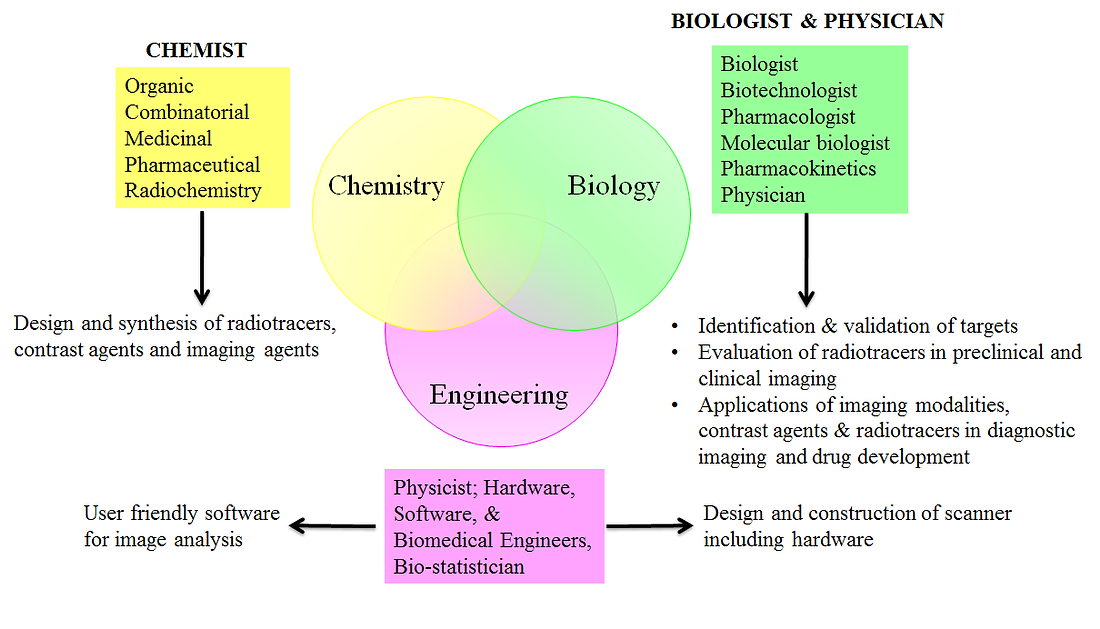

Imaging scanner, radiopharmaceuticals, contrast agents and molecular imaging techniques are widely used for diagnostic imaging in brain, cardiovascular, and metabolic disorders and disease. They are also used in cancer imaging, inflammation and infection diagnosis. The purpose of imaging scanner is to measure anatomical and physiological changes in disease condition. The imaging technology is also used in organ transplantation, regeneration therapy and stem cell therapy. Any pharmaceuticals or therapeutic approach used to treat disease condition can be evaluated with imaging technology.
In pharmaceutical drug development, imaging scanner serve as an effective tool to assess the specificity of new drugs, select dose regimens in clinical trials, and study drug mechanism of action. The technology is also useful in formulation development (e.g. aerosol drug delivery and osmotic pumps). The alpha-particle emitters are used in cancer treatment. Bio-distribution of drug molecules in human body, blood perfusion to various organs, toxicity study and receptor binding studies can be studies with imaging technology.
The new applications are slowly emerging and physicians are using this technology in their clinics. The translational of novel proof of concepts (PoC) or proof of principles (PoP) from bench (lab work) to bedside (clinics) or vice versa is called as translational research.